Categories
Divine Stone

Small Carvings Play A Major Role

A closer view of the often-overlooked work behind the major figures

(Senior Cathedral Guide Tom Fedoreck contributed to this piece)

small carvings
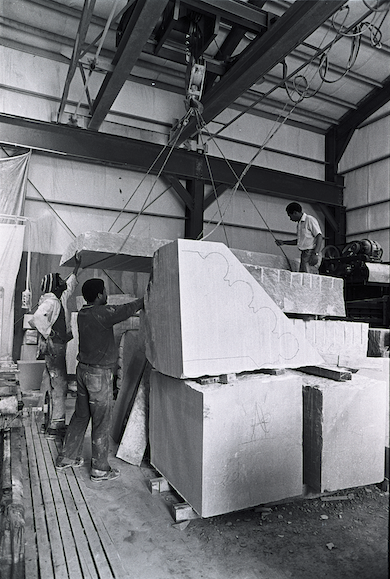
The capitals behind the major-rank figures on the north side of the portal are roughed out on Sept. 26, 1995 and ready for fine carving. Photo by Martha Cooper

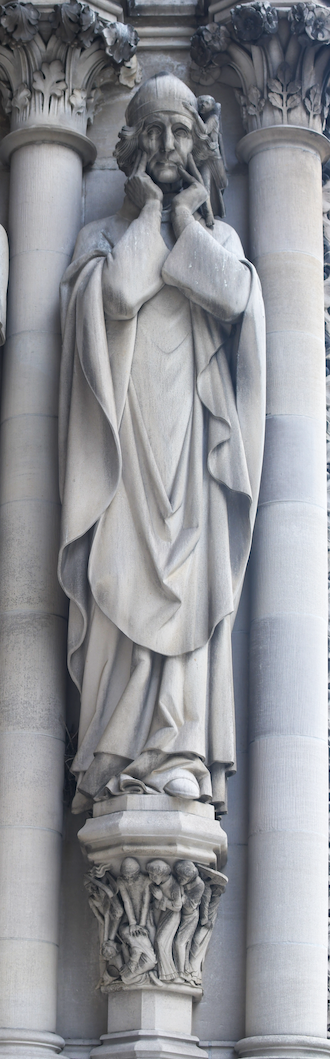
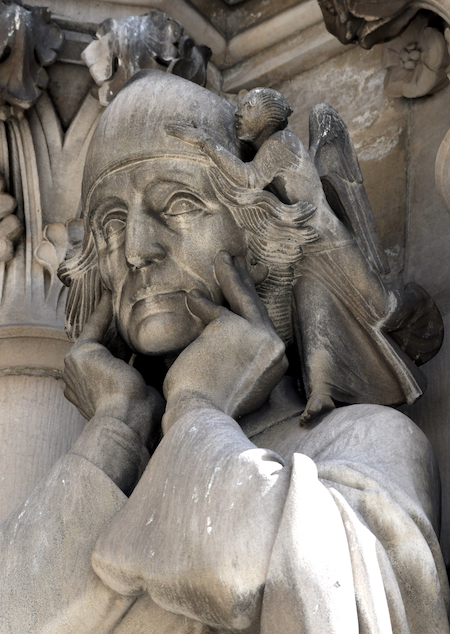
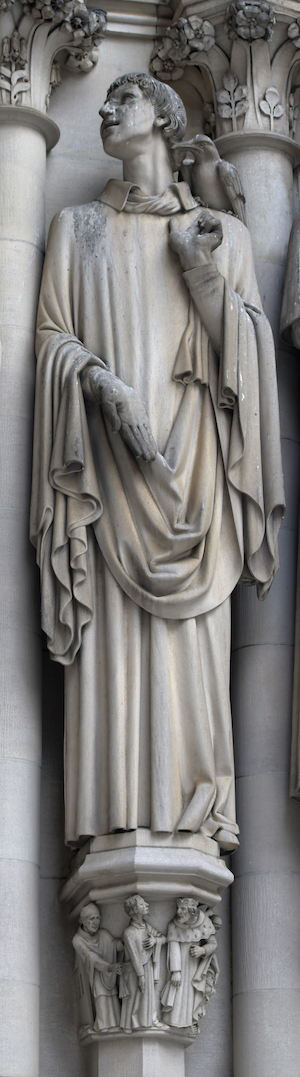
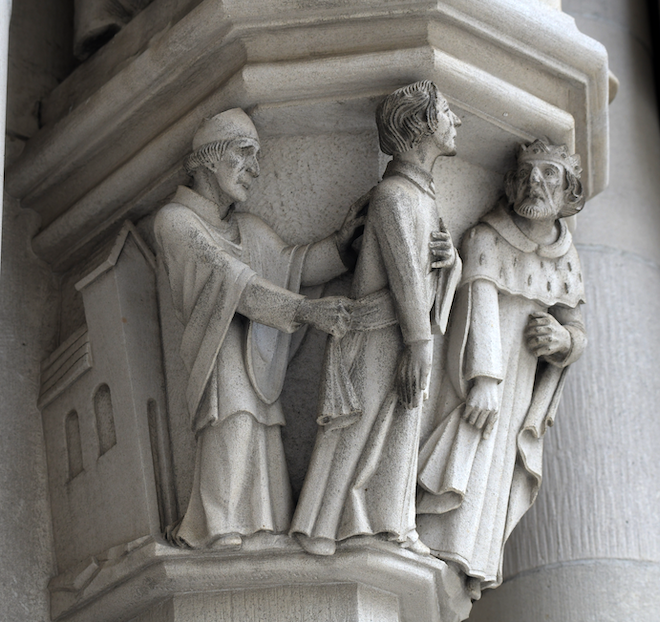
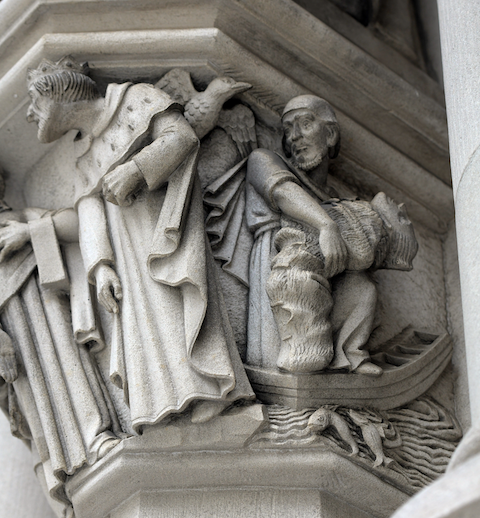
Almost resting on Melchizedek’s shoulder is a dove tending to a nest with two eggs that is a symbol of the holy spirit of creation – “The spirit of God was brooding over the face of the waters.” (Genesis 1:2) The literal meaning of the Hebrew word translated as “brooding” is “to hover like a mother bird over her young.”  

Small Carvings Melchizedek
Above Melchizedek’s shoulder a dove tends to a nest that is a symbol of the holy spirit of creation, seen on Jan. 15, 2026. The six faces above represent Green Men, ancient pagan symbols of fertility and rebirth.

Just above the nesting bird are six long-necked faces covered in foliage, almost like flower petals, and seemingly sprouting from stalks in the earth. Some are open-mouthed, as if taking in fresh air; some have their eyes closed, seemingly squinting in the sunlight. These are Green Men – ancient pagan symbols of fertility and rebirth. They often appear on English cathedrals as symbols of resurrection. There are at least two interpretations of Green Men – and Green Women – on the Cathedral’s unfinished southwest tower

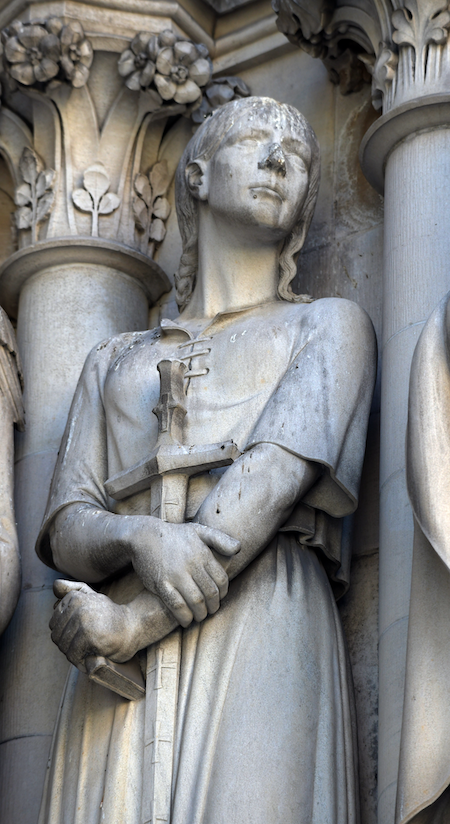
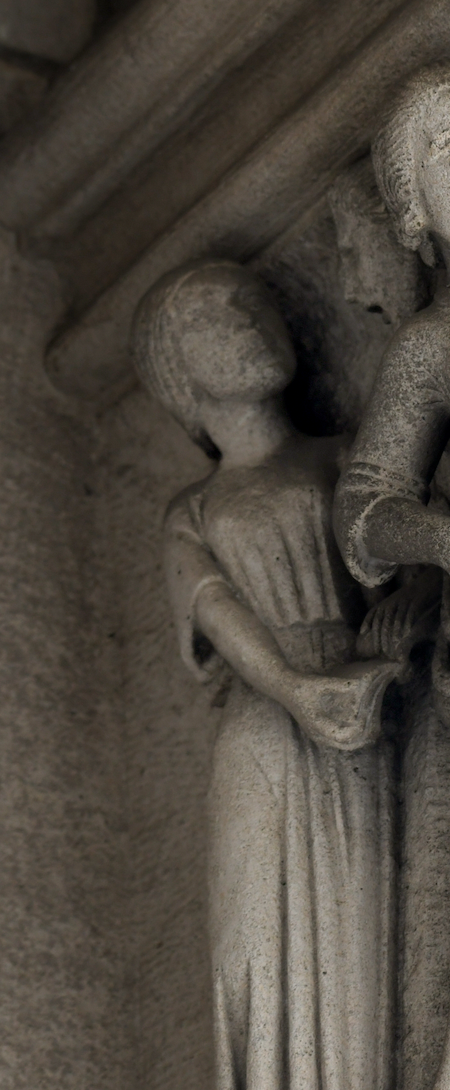
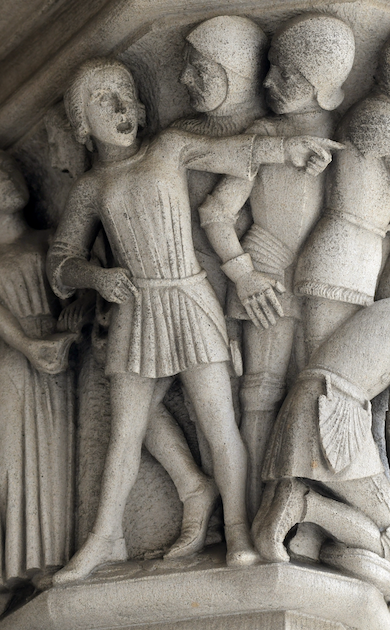
The carvings of two women above the heads of the major-rank figures of Abraham and Sarah depict the same woman at two very different moments – Sarah. 

small carvings Sarah
Both small figures are that of Sarah behind the main figures of Sarah and Abraham of the Portal of Paradise on Jan. 15, 2026

God’s covenant with Abraham promised that he would be “the father of a multitude of nations.” And, for Sarah, “I will bless her and moreover I will give you a son by her.” (Genesis.17:16)

The carving to the left is Sarah, laughing at the notion of an old woman, such as herself, bearing a child. Previously, Sarah had consented to her having her Egyptian maid, Hagar, bear a son, Ishmael, for Abraham. However, once her son Isaac was born, Sarah resented Ishmael and wanted him and Hagar exiled. This explains the carving to the right, which depicts Sarah, angrily pointing her finger as she casts out Hagar and Ishmael.

However, to fully understand the narrative, one needs to look carefully behind Abraham’s left shoulder where two small faces are assumed to be the infants Isaac and Ishamel. After Abraham reluctantly agrees to Sarah’s demand, Hagar and Ishamel nearly perish in the desert, as depicted above in the upper-rank carving.

small carvings Abraham
Two infants, probably Isaac and Ishmael, are seen on the capital behind the figure of Abraham on Jan. 15, 2026.

The third figure on the north side is Jacob, the younger son of Isaac and Rebekah. Above Jacob’s head there is a ladder representing his dream where angels are going up and down a ladder between heaven and earth. He built a pillar of stone where he had the dream and called it Bethel, which means “house of God.” The ladder signifies the divine connection between God and the earthly realm, specifically Jacob’s family. 

small carvings Jacobs ladder
Jacob dreamed that there was a ladder set up on the earth and the top of it reached to heaven, seen on Jan. 15, 2026.

Between the figures of Jacob and Moses, the wide mouth of the portal narrows as it nears the Great Bronze Doors. This pushes the carvings to a different angle, with the geometry and layout changing.

Three slender columns separate the last four major-rank figures. The columns were virtually encased by the raw limestone blocks for the major-rank figures. At the very top, the capitals for these columns met the uncarved jambs, practically creating one continuous surface of stone. Simon and Jean-Claude used that area for extraordinary carvings that literally create a bridge of carvings behind the major figures. 

Carved capitals
View of narrative carvings behind the figures of Moses, Elijah, Elisha and Samuel on the north side on Jan. 21, 2025. Thin columns separate the main figures and provide another carving point.

The viewer sees a fluidity of carving that either moves a story forward or serves as a transitional point. On the first small capital (the top of one of the narrow columns), between Jacob and Moses, there is a transition – hands holding a pyramid. To the left, the palm trees of Jacob’s land of Bethel are visible and, to the right – moving closer to Moses’ figure — we see frogs, the second of 10 plagues inflicted on the Egyptians to convince Pharaoh to free the enslaved Israelites. “Let my people go, so that they may worship me. If you refuse to let them go, I will plague your whole country with frogs.” (Exodus 8:1–4)

Next, moving closer to the major figure of Moses, we see the continuation of the drama of the Exodus.  A swirling pillar of smoke or fire appears which led the Israelites out of bondage. It is said the pillars guided the Israelites through the desert during their rushed departure from Egypt. The pillar of smoke provided a visible guide for the Israelites during the day, while the pillar of fire lit their way by night. Many faces, likely Egyptian soldiers, are barely visible as they are engulfed in the maelstrom.

small carving pyramid
Hands hold a pyramid, beginning a narrative on the Exodus above the main figure of Moses, seen on Jan. 15, 2026.

Above the cyclone of fire and smoke a small figure, likely Moses, raises his staff to part the Red Sea. One carving seems to be an Egyptian soldier engulfed in the tsunami that ensued after the Israelites had made a safe passage on dry land across the Red Sea: “The waters returned and covered the chariots and the horsemen and all the host of Pharaoh that had followed them into the sea. Not so much as one of them remained.” (Exodus 14:28)

While the Egyptian soldiers all perish in the giant waves, the fate of the fleeing Israelites becomes clear in the next transition point. Simon’s interpretation of this moment is an example of his exceptional carving skills. Two figures sit somewhat securely on the next small capital (on the top of the slender column), receding waters visible behind them. We also see the extraordinary image of these characters stretching their arms to incredible elastic lengths to reach other Israelites — their arms also greatly extended towards their rescuers as they are pulled to safety.  

Small carving elongated arms
Behind the face of Moses, figures with elongated arms represent the Israelites pulling others to safety following the parting of the Red Sea. An Egyptian soldier is engulfed in the waves, seen on Jan. 15, 2026.

A three-part tableau unfolds above the heads of Elijah and Elisha.

Simon and Jean-Claude carve captital
Simon Verity and Jean-Claude Marchionni carve the capital behind the major figures of Elijah and Elisha on May 29, 1996. Photo by Martha Cooper

A flock of birds believed to be ravens surrounds a small figure, Elijah, on a capital. Elijah lived during the reign of Ahab, a king of Israel, who worshipped the Canaanite gods Baal, a storm god, and Asherah, a mother goddess. Elijah rebuked Ahab and called down a famine and a drought on the land. Elijah then traveled into the wilderness to hide alongside a brook, where he survived on food delivered by ravens.

small carving Elijah
Detail of carving in progress on May 29, 1999 showing Elijah in the wilderness where he survived on food delivered by ravens. Photo by Martha Cooper

Tongues of flame appear above the major-rank carving of Elijah, recalling the story of the contest between Elijah and the prophets of Baal. Elijah tells the prophets of Baal, “you will call on the name of your god, and I will call on the name of the Lord, and the God who answers by fire, he is God.” The prophets of Baal call on their god to no avail. When Elijah called out to God, “the fire of the Lord fell, and consumed the burnt offering.” The miracle is followed by a massacre of the 450 prophets of Baal in attendance. (1 Kings 18:20-40).

The horses that appear closer to the head of Elisha (and perhaps the flames, as well) relate to the chariot of fire that takes Elijah to heaven in a whirlwind, a narrative also illustrated on the pedestal below carved by Jessica Aujero. (2 Kings 2:1-12).

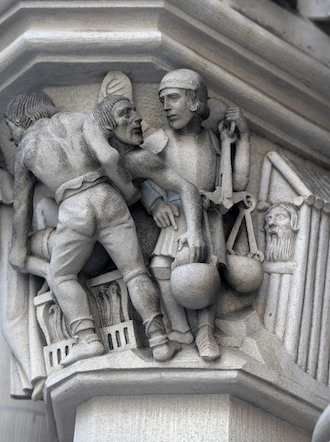
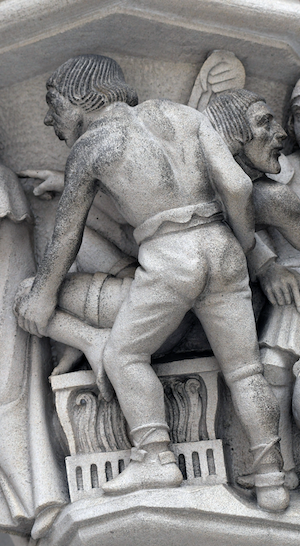
There is a peculiar figure on the column between Elisha and Samuel – the back and buttocks of a man whose arms have no hands and whose head is upside down.

During a war with the Israelites the neighboring Philistines captured the Ark of the Covenant, carried it to Ashdod on the Mediterranean coast, and placed it next to the statue of Dagon in the temple devoted to his worship. The following morning, they found that Dagon had toppled over during the night. The Philistines righted the statue but the next day:  “Behold, Dagon had fallen face downward on the ground before the ark of the Lord, and the head of Dagon and both his hands were lying cut off upon the threshold, and only the trunk of Dagon was left to him.” (1 Samuel 5:3-4)

small carving Dagon
The twisted and broken figure between the figures of Elisha and Samuel, seen on Jan. 15, 2026, represents the idol Dagon.

The battered carving of Dagon is held up on one side by a horse and on the other by a ghoulish hound. 

The last figure on the north side is Samuel and above his head are two figures, one holding his head in his hand, the other strumming a harp. They are Saul and David.

small carving Samuel
Above Samuel’s head are two figures, one holding his head in his hand, Saul, and the other strumming a harp, David. Near the bottom is a carving of a young Samuel with the Ark of the Covenant, seen on Jan. 15, 2026

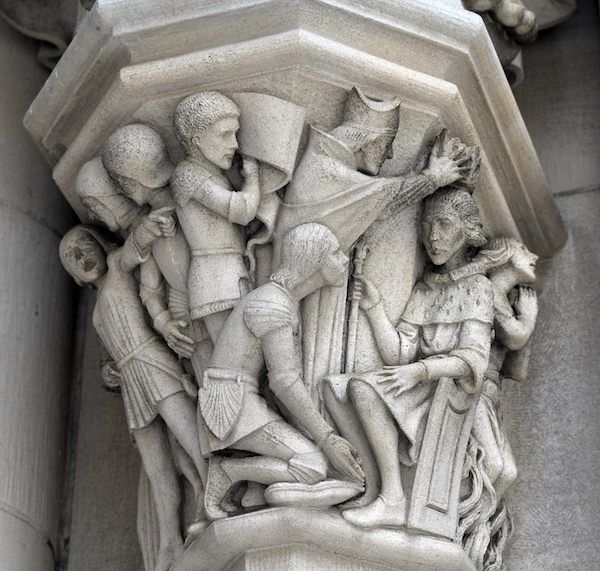
Samuel was called by God to anoint Saul as the first king of Israel, but Saul later proves himself unworthy of the throne. “I repent that I have made Saul king, for he has turned back from following me, and has not performed my commandments.” (1 Samuel 15:10)

Later, during Saul’s reign, God leads Samuel to anoint David as Saul’s successor. (The very next passage describes how Saul was tormented by “an evil spirit from the Lord.” The evil spirit manifests itself in episodes of depression and paranoia. Saul’s servants seek out a man with skill in playing the lyre and find David.  And whenever the evil spirit from God was upon Saul, David took his lyre and played it with his hand, so Saul was refreshed and was well, and the evil spirit departed from him. (1 Sam. 16:23)

Almost hidden on the last capital, to the right of  the major-rank figure of Samuel, is a child standing next to a box. The child is Samuel, son of Hannah and her husband, Elkanah. Hannah, unable to conceive a child because “the Lord had closed her womb.” (1 Sam. 1:6). While visiting Shiloh, where the Ark of Covenant was housed, Hannah made a vow that if God would grant her a son, she would “give him to the Lord all the days of his life, and no razor shall touch his head.” (1 Sam. 1:11).  God answers Hannah’s prayer and Hannah keeps her vow. The image in the portal relates to the calling of Samuel to be a prophet of the Lord, with the box being the Ark of the Covenant. 

A wide array of carvings, showing many different faces, line the south side of the portal above the major-rank figures.

Many small carvings
View of carved figures behind the figures of Jeremiah, Isaiah, Ezekiel, Elizabeth and John the Baptist on the south side of the Portal of Paradise on Jan. 21, 2025.

Above the head of David, we see a sheep next to a lion and the head of a boy next to a sheep. This is a reference to the young David tending his father’s flock of sheep and using his slingshot to kill a lion that had come to ravage the flock.  The story is also a foreshadowing of David’s slaying of Goliath. From this incident, David persuades Saul to let him (David) meet the Philistine giant in one-on-one combat.

Between the major figures of David and Amos, a young David with outstretched arm protects a sheep from a prowling lion, seen on Jan. 21, 2025.

A pair of wild-looking creatures, their faces indistinct, seem to be caught in a swirl of clouds above the heads of Amos and Hosea. Their meaning has yet to be determined.

small carvings above Amos and Hosea
Detail of fantastic carvings above the figures of Amos and Hosea on the Portal of Paradise on Jan. 15, 2026.

Four faces, seemingly with wings behind their heads, line the capital above Ezekiel. 

Ezekiel’s vision describes four majestic cherubim, each with four faces (man, lion, ox, eagle) and four wings, seen Jan. 15, 2026. They could also represent the four Evangelists.

Ezekiel was known for his visions and prophesies, including that, Jerusalem would be captured and the Temple destroyed. One vision describes four creatures, each with the face of a human in front, a lion on the right, and ox on the left and an eagle on the back. They also had two sets of wings.

This same vision appears below in Jessica Aujero’s base carving of the four four-faced creatures. But on the capital carving, they could be linked to the four gospel writers – Matthew, Mark, Luke and John.

Small carving above Elizabeth
Jean-Claude Marchionni and Simon Verity carve the capital relating to St. John the Baptist above the figure of Elizabeth on Sept. 29, 1995. Photo by Martha Cooper

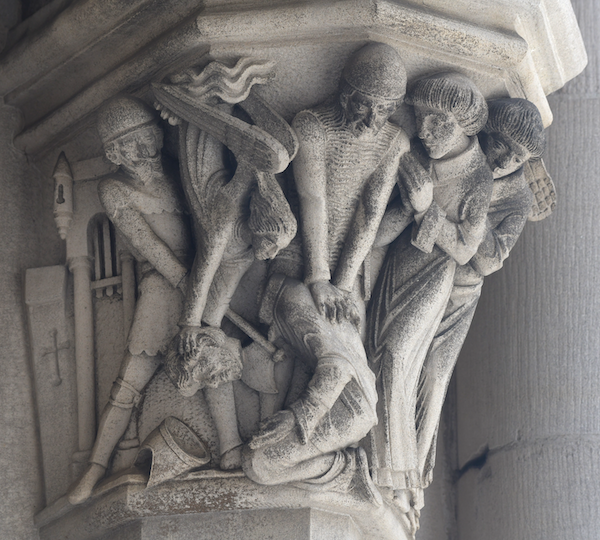
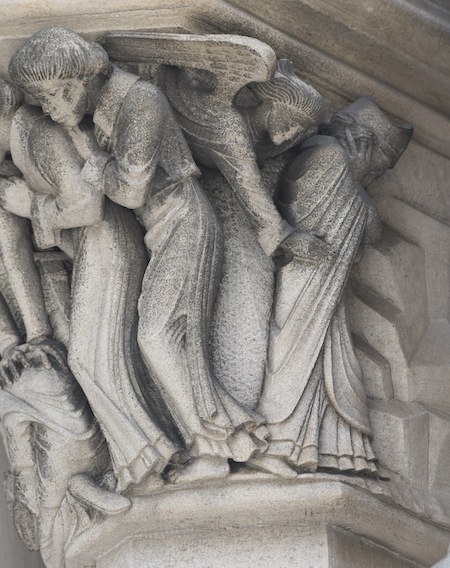
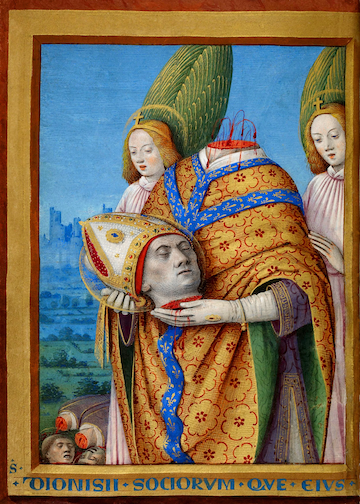
The capital carvings above the major-rank figure of Elizabeth tell of the life and death of her son, John the Baptist. The figure with outstretched arms is John preaching and likely baptizing as well, since he is dressed only in a loincloth. The chains represent his imprisonment, as does the image of the man behind bars, and the head on the platter, the manner of his execution.  It is unclear whom the mournful female face represents. 

Small carving above Elizabeth relating to the life John the Baptist
Detail of carvings on the capital behind the figure of Elizabeth on Jan. 15, 2026 depicts the imprisonment and beheading of John the Baptist by Herod.

The last carving, above the major figure of John the Baptist, shows a lamb with its forelegs bound for sacrifice. A hand cradles the lamb as well as a dove. Here, it represents the Holy Spirit that hovered over Jesus in the form of a dove after John baptized him. When John lays eyes on Jesus for the first time, he cries, “Behold the Lamb of God, who takes away the sin of the world” (John 1:29). The sacrificial lamb has been a fundamental symbol of Jesus since ancient times. As for the hand, it is the hand of God the Creator. Hence, John stands beneath symbols of the Father, the Son, and the Holy Spirit — the Trinity.

small carving above John the Baptist
Jean-Claude Marchionni works on the capital behind the major-rank figure of John the Baptist which depicts a lamb prepared for sacrifice on Sept. 29, 1995. Photo by Martha Cooper


Categories
Divine Stone

Carving the Major-Rank Figures

Simon Verity as a Medieval Image Maker

For more than five years now, “I’ve been carving a necklace of prophets around the Cathedral’s throat, slowly, painfully, intuitively,” said Master Carver Simon Verity during a November 1993 lecture titled Work in Progress. “I’m searching out the wellsprings that gave life to the work of a medieval image maker. The opportunity to carve a whole wall of statues was unique. There is nothing like it going on in Europe.”

Simon Verity with finished portal
Simon Verity poses by the Portal of Paradise, undated photo by Martha Cooper.

During this presentation, Simon outlined his process in carving the major-rank figures of the Portal of Paradise at the Cathedral of St. John the Divine, which he was tirelessly working on at that time. Simon’s complete manuscript was recently uncovered in the Cathedral archives and included a number of drawings; some segments are presented below. 

“Dean (James Parks) Morton explained to me the significance of the ‘Easter Doorway.’ Patriarchs and matriarchs were to be carved to act as a procession to lead us into the interior, where we are to be transformed and then we go out through the side doors as martyrs, priests, doctors, whatever we are called to be,” Simon continued.

Simon viewed the task – to carve 16 major figures on 12 eight-foot-tall limestone jambs — as that of a “craftsman to clothe the iconography in form. The stem is the right ordering of the form through geometry. The fruit is a legible piece of work. If the work is true, it will be good, it will be beautiful,” he said during his talk.

Simon Compass

“An icon painter writes his icon. The actual word, iconographer means ‘image writer,’” Simon explained. “And his work must be legible to whoever has to read it…The iconographer’s job is to clearly display the icon, which is the art itself…My work as a craftsman is to take the iconography given to me by the priests and clothe them in form.”

Carving the major-rank figures
Simon Verity carves on the north side of the Portal of Paradise in an undated photo by Mary Bloom. From left, the major-rank figures are Abraham, Jacob, Moses, Elijah/Elisha and Samuel

This major work gracing the west façade of the Cathedral of St. John the Divine was not Dean Morton’s first choice for a carving project.

In the late 1980s, the Dean created a limited international competition to find a sculptor to create and install the figures for the Preachers’ Portal on the porch of the southwest tower. The task involved carving the eight figures in a workshop, then installing the finished carvings in the empty niches on the porch. The tower — St. Paul’s Tower– was under construction and the focus of the Stoneyard Institute at that time.

In April of 1988, Simon visited the Cathedral and told Dean Morton that he would instead carve the figures at the central portal – which leads to the Great Bronze Doors. This made the project immensely more visible. Unlike the Preachers’ Portal, where the jamb stones could be carved in a studio and placed into the proper slots, the central portal blocks had been set at the portal in the late 1930’s and would have to be carved in situ – in place. 

“Putting in the uncarved blocks of stone like this was a mistake made by the architect (Ralph Adams Cram’s 1925 design), who thought that was how they did it in Chartres,” Simon wrote in an essay.

There were a total of 12 limestone blocks, each eight-feet tall, for the major-rank figures. The designated figures from the Old and New Testament were specified in the original plan, which Dean Morton described as “all male and unimaginative.” So, he assembled a group of religious theologians, including the Rev. Minka Sprague, who was a professor at New York Theological Seminary and a Deacon at the Cathedral, and Rabbi José Rolando Matalon, Senior Rabbi and Rosh Kehillah (Head of the Community) at B’nai Jeshurun in New York City, to update the list. Ultimately, there were more names than there were blocks. Simon would have to incorporate two figures on several of the jambs. 

Simon also wanted this significant undertaking to blend with other architectural elements of the Cathedral.

He continued his lecture: “With the geometry, I have recently been helped by the master (geometer) Michael Schneider. With him, I was able to resolve connections between the images to be carved and the architecture. The space taken by the statues in elevation is expressed geometrically in two vertical intersecting circles, all together symbolizing the Trinity. The floor plan of the Western doorway reveals intersecting octagons. So we can tie this symbol of the Trinity to the floor plan which relates to humanity and resurrection.”

Michael S. Schneider is an educator and author who wrote A Beginner’s Guide to Constructing the Universe: Mathematical Archetypes of Nature, Art, and Science and Mathematical Ideas for Artists Workbook. Schneider tells us, “he (Simon) organized the individual sculptures harmoniously with each other and with the building and space before it.”

“From points on the circumference of the circles on the wall, I can find departure points for my silhouettes that will need to be read from across the street,” Simon said. “By taking string lines from the octagons, I can mark out my main planes in plan. The link will be a sound harmonic that will give me the main shadows and mid distance.”

“The prophets are already in heaven, so they are draped in heavenly robes. This links them to the architecture with the shadows echoing the mouldings. As I work, the geometry unfolds like a flower, in plan, as a means of elevation,” Simon added to his lecture.

Also imbedded in the geometry is subtle body positioning of the figures and the direction of their gaze.  Simon carved the eyes of each sculpted figure to follow the visitor up the stairs in their sequence–each looking at a key point in the geometry, then passing us to the next set of eyes, all watching us enter each step from the street up to the central front doors and through the Great Bronze Doors.

According to Cathedral docent Tom Fedorek, “an intriguing aspect of the Portal of Paradise is how Simon Verity uses gaze to delineate relationships among the figures. The figures appear on the portal in chronological order from the outer figure on the north side (Melchizedek) to the outer figure on the south side (John the Baptist).”

Major-rank figure of Melchizedek
The major-rank figure of Melchizedek is well defined and its gaze looks into the entire Portal of Paradise composition in a July 1989 photo. Below, Master Sculptor Simon Verity and Amy Brier work on pedestals on the north side. Photo by Robert F. Rodriguez

This could explain why Simon’s first major carving was that of Melchizedek — so he could set a line of sight and connection to other figures carved later. Even though they are on diagonally opposite ends of the portal, two kings, Melchizedek, first king of Jerusalem, and David, its greatest king, look at one another.

Carving the major-rank figures
Simon Verity carefully chisels the face of Melchizedek on Oct. 26, 1988. Photo by Robert F. Rodriguez

Conversely, a recently contributed photo indicates that the first figure Simon carved on the south side was that of David.

Carving the major-rank figures
Progress photo of Simon Verity carving the south side major-rank figures. He started with the figure of David, whose gaze is directed at Melchizedek on the north side. Undated photo by Ivan Myjer

David’s body is angled so that his gaze falls on his predecessor, Melchizedek, who returns David’s gaze. Furthermore, directly across from David, Samuel’s gaze rests on David. Samuel, the last and greatest of the judges and the first of the great prophets since Moses, recognized David as a future king and anointed him.

We see a different and equally dramatic use of gaze on the figure of John the Baptist – the outermost carving on the south side of the portal.

He is the one figure not looking at any of the other figures in the portal composition. Rather, he looks out at the city and incoming worshippers because, as he said of himself: “I am the voice of one crying in the wilderness. Make straight the way of the Lord.” (John 1:23). 

Carving. the major-rank figures
Progress photo of carvings on the south side of the Portal. Simon applied red water base paint as guides for carving. Undated photo by Ivan Myjer

There is one more notable feature about this figure – Simon carved the likeness of John the Baptist based on a homeless man who frequented the Cathedral at that time.

There is a connection, perhaps a shared gaze, between two of the female portal characters added by Dean Morton and his committee. It revolves around two mothers who conceived children in old age. Significantly, Sarah and Elizabeth are positioned directly across from one another in the portal. Sarah, on the north side regards Elizabeth, linked by the miraculous births of their sons, Isaac and John. Sarah, here, represents the Old Testament while Elizabeth appears in the New Testament Gospel of Luke.

While Simon carved the vast majority of the major-rank figures, he received help from a few other carvers.

Jean-Claude Marchionni, who was working on outside projects and restorations for Cathedral Stoneworks, joined Simon in 1993. In his lecture, Simon said of Jean-Claude, “I have been so helped by a young French stonecutter, Jean-Claude, who brings his own order and clarity, so that we work as (a) focused team.”

Jean-Claude carving Amos/Hosea, major-rank figures
Jean-Claude Marchionni carves the major-rank figures of Amos/Hosea on the south side of the Portal of Paradise in an undated photo by Amy Brier.

Simon also acknowledged the work of the apprentices as “young American carvers from the (stone) yard (who) poured out their passion and their pioneering spirit, only held in check by the architectural frame and the theology they served.”

Sebastien Casamayor, part of an exchange program with the Cathedral of St. Jean Baptiste in Lyon, France, carved parts of the major-rank figures. Simon once remarked that Sebastien “had thick velvet pants that the dust fell from at the end of the day, with a pocket to hold a bottle of wine – a standard feature in Dijon.”

Sebastian Casamayor carves Jacob
Sebastien Casamayor works on the major-rank figure of Jacob in an undated photo by Amy Brier.

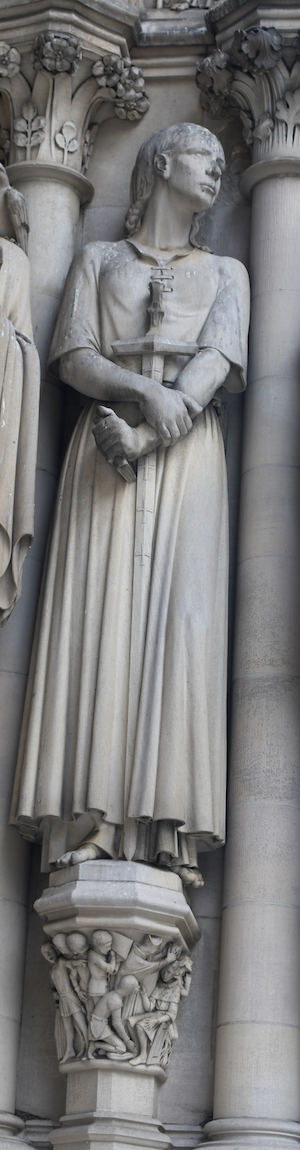
Sebastien, according to a Cathedral guide to the portal, carved a significant element on the figure of David – the lyre he is holding. In Simon’s carving, David wears a crown and holds a scepter in his left hand, signifying his kingship. His right hand rests on the elongated instrument, which represents joy and divine connection. Many of the ancient hymns known as the Psalms are attributed to David. 

Patrick Berthaud, another French-trained carver, who spent seven months at the Cathedral, also assisted Simon on the portal when time allowed.

Simon Verity and Patrick Berthaud
Master Sculptor Simon Verity, left, is seen on the scaffolding with Patrick Berthaud during work on the Portal of Paradise. Patrick spent seven months at the Cathedral during an exchange program with the Cathedral of Saint-Jean Baptiste in Lyon, France. Undated photo by Patrick Berthaud

Of all the carvings of the major-rank figures, the face of Moses is the most unusual. His half-covered face refers to a passage in Exodus after Moses returned from Mount Sinai.

Moses Gaze
The figure of Moses, third pedestal from right, shows his partially covered face. The gaze of all the north side carvings seem to look down as people walk closer to the Great Bronze doors. Courtesy the Episcopal Diocese of New York and Cathedral Church of St. John the Divine

The same Cathedral guide indicates that apprentice Dennis Reed carved the head of Moses – or at least, part of it.

The importance of gaze also comes to play here – Moses looks away from the Cathedral because he never reached the Promised Land.

After Moses led the Israelites through the wilderness, he had an encounter with God on Mount Sinai. When Moses came down from the Mount with the two tablets of the testimony in his hand, he did not know that the skin of his face shone because he had been talking with God. “And, when Aaron and all the people of Israel saw Moses, behold the skin of his face shone and they were afraid to come hear him … And when Moses finished speaking with them, he put a veil on his face.” (Exodus 34:29-30,33).

Simon Geometry of the Face

Two symbols on specific figures literally create Simon’s “necklace” around the entire portal composition. On his first carving on the north side, Melchizedek holds in his hand a chalice like those used for communion wine. Beneath his feet, two hands hold the consecrated bread – a Host.

Simon Verity pedestal of Eucharist
Simon’ Verity’s pedestal shows two hands holding up a Eucharist wafer with a lamb on it symbolizing Christ as the Lamb of God. Undated photo by Martha Cooper.

Across from Melchizedek, on the south side, John the Baptist holds a shell, an ancient symbol of fertility and life. To this day, a shell is often used to administer the water of baptism. John is the final major-rank figure of the Portal of Paradise.

The shell in John’s hand signifies baptism, the chalice in Melchizedek’s, the Eucharist.

The figure of Moses bathed in sunset light
The figure of John the Baptist is bathed in the intense light of the setting sun, seen on June 2, 1996. John holds a shell, a symbol of Baptism. Undated photo by Martha Cooper.


So, as you step into the cathedral’s central entryway, you are flanked by symbols of the two great Christian sacraments that are celebrated within the cathedral.

Later in his presentation, Simon said, “As I go down my journey, I think about the traditional craftsman. His work is all connected with gods and heroes so it belongs on temples and churches. His workplace, however humble, is his altar. It is but a different form of priesthood. His work is sacred and he blesses his tools before each day’s work.”

Portal figures watching over St. Francis Day procession
A St. Francis Day procession departs the Cathedral with the major-rank figures watching from above. Undated photo by Martha Cooper.

Sources:


Categories
Divine Stone

Remembering Nelson Otero

(Robert F. Rodriguez has gathered memories of Nelson from family and colleagues from the stoneyard. – RM)

Remembering Nelson Otero
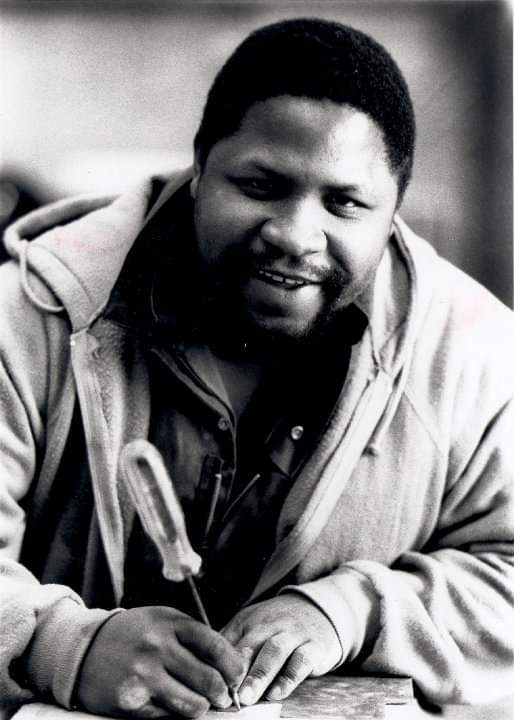
Nelson Otero (April 21, 1955. – December 15, 2025)

I had the most amazing dad. I remember spending days with my Dad at the Stoneyard when I was a child. Some of the best memories watching what my dad loved to do. He loved the Stoneyard and everyone he worked with.

– Gloria Otero

“I remember Nelson particularly for being immediately friendly when we met. 

“When he introduced himself he explained his role at the yard and I could tell he was proud of the work he was doing. I could also tell from this first impression that he was a determined and resolute guy.  

Remembering Nelson Otero
Nelson Otero cleans up after making repairs and maintenance to the planer’s mechanisms on March 13, 1981. Photo Robert F. Rodriguez

“He was a prominent, respected and industrious member of the stone yard crew, and the only one to fully master the idiosyncrasies of the planer, an antiquated, deafening beast of a machine used for milling long sections of stone moldings. This job required a lot of strength and the planer was a potentially very dangerous machine to operate. Not everyone’s choice of work but Nelson was clearly equal to the task and rose to the challenge taking a great deal of pride in his accomplishments. His work can easily be seen today in the jambs, mullions, piers and cluster columns of the South Tower.

“Nelson was never reluctant, in fact relished taking on demanding and physically challenging assignments. This included scaffolding projects requiring a lot of strength and the ability to work at height, again not everyone’s choice but he never complained or showed any signs of apprehension.

“His contribution to the stone yard and tower was tremendous. I am very grateful to have known him and greatly saddened by his untimely passing.”  – Stephen Boyle

Neson Otero and Alan Bird discuss planer
Planer operator Nelson Otero and Master Mason Alan Bird check a large block before setting the blade to shave an edge on July 2, 1980. Photo Robert F. Rodriguez

“I didn’t have the pleasure of working with Nelson, but as a fellow Stone Mason, I am deeply saddened for his passing. I send condolences, from me and my children. In my heart, I feel that he is in that Great Stone Yard in heaven, with our Brothers and Sisters, Masons, designing our castle.” – Carol Hazel

Remembering Nelson Otero
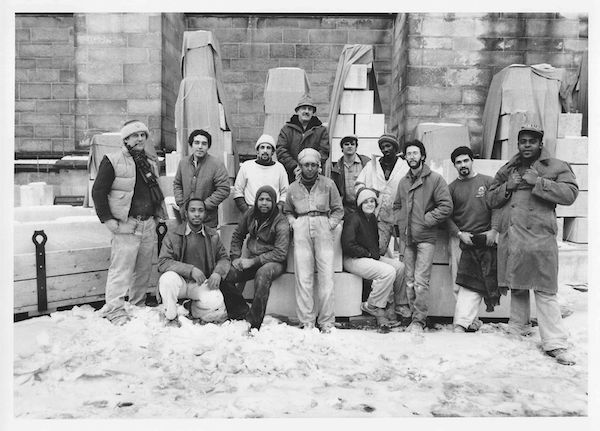
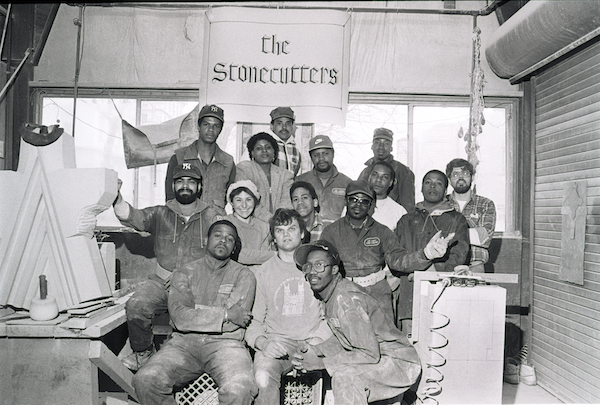
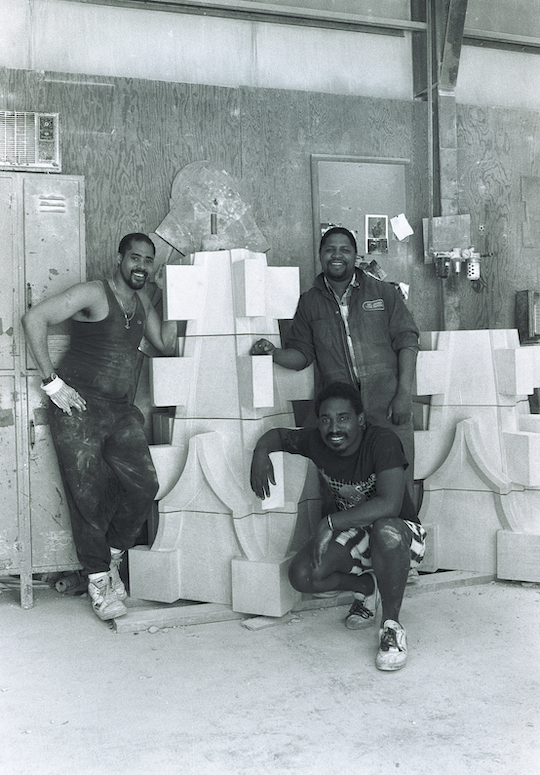
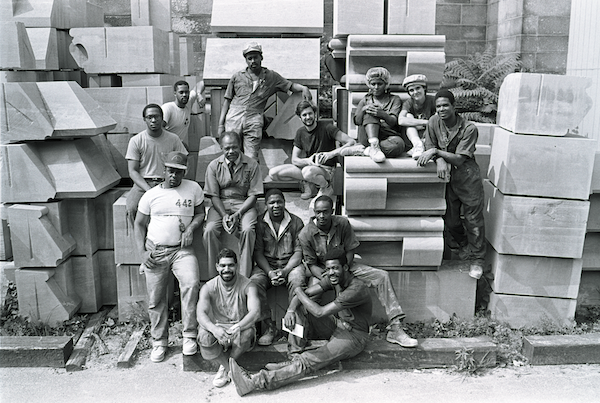
Posing for a group photo – Front row: Timothy Smith, Steve Boyle, Eugene Smith, James Bambridge, Dean James Parks Morton, James Jamerson (with hand on Dean’s shoulder), Maurice Armstrong (in front of James J.), Johnny Armstrong, Robert Stanley, Nelson Otero, Arlene (Poni) Baptiste. Middle row: D’Ellis “Jeep” Kincannon, Ruben Gibson, Alan Bird, Cynthia (Cynie) Linton, José Tapia, Yves Pierre. Back row: Eddie Pizarro, Angel Escobar, Eddie Gibson, Joseph Kincannon. Stacked to the left are cornice stones waiting to be carved. Photographed March 17, 1983. Photo Robert F. Rodriguez

“It saddens my heart today to know that a great family man, a good friend and a great Craftsman passed away. Back in October ‘91 was the first time I met Nelson. He was a big chap. Very quiet and controlled. He very kindly took me aside and explained the way the Cathedral worked and New York City as I was only 23 and from the countryside in England. Hill Street Blues TV show was all I knew. But, Nelson was grateful that I had come to the Cathedral and told me “I got your back.” He probably had something to do with why I stayed here in the US. Thank you Nelson and God bless his family.” – Chris Pascoe

Chris recalls a time when his car was parked outside the Cathedral, all set for a ski trip. When Chris came back to the car a while later, he saw that his car was broken into and all his equipment stolen. He said something to Nelson who disappeared for a while and came back an hour later with almost all of Chris’s gear. Nelson clearly found the unfortunate guys who had broken into Chris’s car.

Remembering Nelson Otero
Head Mason trainer Christopher Pasco, left, shows a zinc template to Cathedral Stoneworks crew members Jason Bird, James Fowler, Lisa Young and Christopher Pellettieri. Behind them are Stephen Boyle, Ricardo Telemaque and Nelson Otero. Seen in an undated promotional photo.

“Nelson was a kid from the neighborhood, growing up on W. 94 St and Amsterdam Ave – about a mile from the Cathedral that would be his home for over a dozen years – from 1980 to 1994.
I remember him as diligent and precise in his work. As others have said – no one touched Nelson’s planer – a cantankerous, sometimes obstinate machine that only he could tame. There were times when I would see Nelson and Cathedral mechanic Barney Norman climbing all over the arms, tightening and adjusting belts and flywheels. And when he had that planer fine-tuned, he could trim and shape a long block of limestone in a flash.” – Robert F. Rodriguez

Barney Norman and Nelson otero repairing planer
Barney Norman and Nelson Otero climb to the top of the planer’s mechanisms to make repairs and maintenance on March 13, 1981. The machine was found abandoned in the limestone quarry in Indiana and was refurbished from other old machines before making its way to the Cathedral stoneyard. Photo Robert F. Rodriguez

“In the stoneyard, newcomers were usually assigned to the saws, a common starting point before moving on to training as a stone cutter, banker mason. Nelson became the first planer operator—that beast of a machine, found abandoned near the quarry and then renovated. An English operator came to train Nelson and planned to stay for two to three weeks. By the end of the first week, Nelson had it all figured out, and his trainer left. Nelson was the mechanical genius of the stoneyard and owned the giant planer. He broke the tradition of moving from the machines to the stone cutter’s area. Jose Tapia encouraged Nelson to try his hand at stonecutting and tutored him in the process. Nelson told me it just didn’t do for him what working the giant planer did. He would operate that machine with pride for many years.” – Roger Murphy

Jose Tapia showing Nelaon Otero some carving pointers
José Tapia instructs Nelson Otero on how to handle a chisel April 13, 1981. Nelson usually worked on the planer and was receiving some pointers on cutting stone from José. Photo Robert F. Rodriguez

Nelson was always so helpful at the stoneyard. Nelson knew that Angel had a talent for drawing and wanted something special for his daughter’s bedroom so he asked Angel if he could paint The Little Mermaid on his daughter Gloria’s bedroom wall. Nelson was so excited to have it done for her. – Angel Escobar

Remembering Nelson Otero
Nelson Otero cleans up after making repairs and maintenance to the planer’s mechanisms on March 13, 1981. Photo Robert F. Rodriguez

“Nelson was the planer operator. I can’t remember anyone else taking on the beast…with the exception of Alan. The machine was old and unruly, and could be downright violent. Once it backed up and punched through the corrugated metal wall giving the hotdog man on the street side quite a scare. The planer was located in the northwest corner of the machine shop. Nelson’s domain.

Remembering Nelson Otero
Nelson Otero tightens bolts on the planer to set the blade in place on Feb. 6 1981. Photo Robert F. Rodriguez

“Nelson was very industrious, and an aggressive entrepreneur. While most of us were struggling to pay rent, Nelson owned at least one tenement building before the age of thirty. He always had multiple projects in the works. He once asked me if there were any good junk shops up in New England. I told him there were many, and asked if there was something in particular that he was looking for. Without missing a beat he reeled out that he needed a dozen metal work tables and a 100 sewing machines. I guess I looked stunned. He explained that his wife was moving into fashion design and that he needed as many sewing machines as he could lay his hands on.

Remembering Nelson Otero
Nelson Otero sets the blade on the planer to continue rounding a stone’s contours in July, 1981. Photo Robert F. Rodriguez

“Another time he asked where he could buy a fleet of used trucks. Not one or two…a fleet. I think he wanted to start a moving company. He didn’t do anything in half measures. And yet another time he caught me and Jeep on the street asking if we could help him unload a truck load of old window frames and toilets. He was always working on old buildings.

remembering Nelson Otero
Nelson Otero uses a long crowbar to move a huge limestone block into position under the frame saw as mechanic Barney Norman looks on March 13, 1981. Photo Robert F. Rodriguez

“He was also into physical fitness. I remember him hanging by one leg from the metal staircase outside the machine shop doing air sit-ups. I’d never seen that before. He would also have us do competitions to see who could carry the most bricks pinned between our forearms – no easy feat. He also gave out instructions on what to do in a street fight. I’ll leave out the details, but I remember it verbatim.” – Joseph Kincannon

Nelson Otero in Popular Mechanics
Nelson Otero appears in an August, 1983 Popular Mechanics article on the stoneyard.
Categories
Divine Stone

Merry Christmas from the Dean

(This is an encore post from five years ago, December 20, 2020, that seemed appropriate to repeat. Happy Holidays to all from Divine Stone.)

Merry Christmas from the Dean
Signed Christmas card to Steve Boyle

In 1989, Dean Morton asked D’Ellis “Jeep” Kincannon to create an architectural drawing of the Tower of St. Paul. This was the tower being constructed and a symbol of the working stoneyard. Parts of individual construction drawings, stitched together, formed the entire new drawing. The result was one complete drawing of the west face of the southwest tower, to scale, with every stone numbered. It also shows the construction zones A (lowest) through K (highest) and FP, from elevation 239’3″ to 393’0″. Dean Morton sent the drawing out as Merry Christmas from the Dean. Signed at the bottom right.

West Tower Drawing
Reduced drawing to fit on the blog, actual size three feet by eight feet

The “card” must have amazed the recipients. It measured three feet wide and eight feet long. The detail and the precise joining of different drawings made for a beautiful presentation. “Jeep” Kincannon was justifiably proud of his work.

Detail West tower
Detail of composite drawing assembled by “Jeep Kincannon


A Symbol of Pride and Love

The Dean was ever so proud of the stoneyard and the workers which is probably why he wanted to send this impressive statement to friends and colleagues. It was symbolic in many ways. A story he once told involved a question from one man to another. The question asked was “What do you give a poor man?” The answer:

You give him a dollar for bread, and another one for a flower.


Dean Morton knew the spiritual impact of the Cathedral building program on the community. At a time when the neighborhood was struggling in so many ways, some thought that all funds should be directed to social programs. In a way, the stoneyard was his flower to the community.

Dean James Parks Morton
Smithsonian Magazine – Photo Tom Sobolik
  • Thanks to Stephen Boyle for sharing his Christmas card with us and to Pamela Morton for the Dean’s photo.


Categories
Divine Stone

Dry Bones and Tiny Towers

(This is Part Two about the early work on the Portal of Paradise. It is written by DivineStone co-author, photojournalist and Cathedral Artist-in-Residence, Robert F. Rodriguez. All of the images in the article are those of the writer except where noted) – RM

Apprentices Tackle Portal Bases on South Side

In the spring of 1989, Master Sculptor Simon Verity hoisted a few planks onto thin steel frames to start the first full carving season for the Portal of Paradise.

The portal project
The figure of St. John the Divine seems to supervise roughing out the stone jambs with Joseph Kincannon and Amy Brier, top, and Dennis Reed and Gabriele Hiltl-Cohen on the lower platform on Sept. 14, 1988.

The crew of Jessica Aujero, Joseph Kincannon, Dennis Reed and D’Ellis “Jeep” Kincannon had their assignments for the pedestal bases on the south side and started the roughing out. 

Dry Bones and Tiny Towers
Master Sculptor Simon Verity examines a block on a pedestal while Angel Escobar, Jessica Aujero, Joseph Kincannon, standing, watch. Dennis Reed, far right, starts roughing out his pedestal base on April 19, 1989.

Jessica Aujero created an eerie and haunting work for her base carving. Beneath the major-rank figure of Ezekiel, she presents his dream in the Valley of Dry Bones, a prophecy in chapter 37 of the Book of Ezekiel.

Jessica carving her pedestal
Jessica Aujero carves an intricate pedestal stone showing Ezekiel’s dream in the Valley of Dry Bones, seen in November, 1988.

On the upper part of the pedestal, we see grimacing skulls, struggling to free their bones from the earth. They lean forward menacingly, as if they intend to leap off the limestone base. Jessica also adds carvings of angels, some with animal faces, wheels with eyes and God’s chariot and fire — all representing total destruction.

Dry bones and tiny towers
Jessica Aujero carved this pedestal symbolizing Ezekiel’s dream in the Valley of Dry Bones, seen on July 15, 2023.

At the very bottom of the carving, below the chaotic scene, is a sleeping Ezekiel. A disembodied hand touches his head, probably indicating that the reclining figure is dreaming, or it could be God’s hand commanding the prophet. Ezekiel finds himself transported by God’s spirit into a valley filled with dry, lifeless bones. God commands Ezekiel to prophesy over these bones, and as he does, they come to life, growing sinew, flesh, and skin. Yet, they lack breath, symbolizing Israel’s spiritual condition at the time. Following God’s instruction, with a gust of wind Ezekiel  breathes life into them, and they come to full life, symbolizing God’s promise to revive Israel.

Dennis Reed viewing pedestals
During a cigarette break Dennis Reed studies the pedestal carvings on the south side of the Portal of Paradise on April 17, 1990. From the left can be seen works in progress by Joseph Kincannon, Jessica Aujero, Dennis Reed and D’Ellis “Jeep” Kincannon.

A September 1989 Cathedral Newsletter conveys Dennis Reed’s process of carving the Visitation. “Beneath the feet of Elizabeth, mother of St. John the Baptist, Dennis Reed roughs out the figure of the older Elizabeth comforting the 14-year old Mary, who has come to her with the wonderful and terrifying news that she is somehow pregnant herself.”

“To carve this scene, I had to reach into myself, really think about it,” says Reed. “I see Mary right then as overwhelmed, confused, frightened. She went to Elizabeth for comfort.” 

Dennis Reed carving his pedestal
Dennis Reed carves The Visitation – Mary visiting Elizabeth while they are both pregnant – on April 17, 1990. He is carving streams of flowing water to symbolize motherhood.

Below the figures of the embracing women, Mary at Elizabeth’s knees, a pot overflowing with water is symbolic of motherhood. The water is also a symbol of the water John the Baptist would later use to baptize Jesus. (John the Baptist is also the last major-rank figure on the south side of the portal.)

On the column shaft, Dennis displays great artistry and carving skill in his depiction of an embryo bathed in the softly flowing water that gently cascades from the edges of the column. Delicate tiny toes and the outline of legs and a torso are suspended upside down, as if in the womb. They are barely visible, seen as though through a gossamer veil. 

Dennis Reeds Completed carving
This is a view of Dennis Reed’s completed Visitation carving, seen on July 15, 2023.

The Cathedral article adds that from his perilous perch on the scaffold, Dennis enjoys the changing of the seasons and the enthusiasm of the passersby who stop to watch. “We hope we’ll be out here until October or November,” says Reed. “We see people in everything from T-shirts to mink coats.” He pauses a moment. “It breeds patience.”

D’Ellis “Jeep” Kincanon was a multi-talented member of the Cathedral Institute and sometimes had to move between projects.

Jeep Kincannon carves on pedestal
D’Ellis “Jeep” Kincannon shapes vines below the main carving of John the Baptist in Aug. 1989.

Jeep started carving honeycombs and carob trees on the column shaft beneath the major-rank figure of John the Baptist. He was pulled off this job since he was also needed by Cathedral Stoneworks to work on templates for a project at the Jewish Museum. Several years later Jean-Claude Marchionni carved the upper half of the pedestal – adding oversized ears and a hand to instruct all to listen to the preaching of John, which foreshadows the coming of Christ. 

Completed carving Jeep Kincannon and Jean-Claude Marchionni
This is a view of the completed carving below the upper-rank figure of John the Baptist, seen on July 15, 2023. The lower portion of vines were carved by D’Ellis “Jeep” Kincannon in 1989 and finished several years later by Jean-Claude Marchionni.

Jean-Claude would also go on to carve the two remaining pedestals on the south side. Beneath the major-rank figure of David, we see the entry of the Ark of the Covenant into Jerusalem (II Samuel 6). David is seen dancing to the left of the Ark and is semi-nude per the scripture (II Samuel 6:20). The chorus line of women below are dancing and making music to celebrate the Ark’s arrival. On the adjacent base Jean-Claude carved the Brooklyn Bridge collapsing. Snakes, spiders, skeletons — these images echo the words of the prophets of evil, malice, and doom.

Probably the most viewed and most recognizable carving on the Portal of Paradise is Joseph Kincannon’s depiction of New York City, including the Twin Towers, under a nuclear mushroom cloud.

Joseph Works on carving.
Joseph Kincannon carves New York City under a nuclear mushroom cloud, interpreting the modern day destruction of Jerusalem, seen on Sept. 3, 1989.

The prophet Jeremiah foretold the destruction of Jerusalem and Joseph’s carving below that major-rank figure interprets the modern day destruction of Jerusalem by using the instantly recognizable skyline of New York City. The Gothic arches below represent the rebuilding of the “cathedral,” a symbol of hope after chaos.

Joseph Kincannon's finished carving.
This is a closeup of Joseph Kincannon’s pedestal carving seen on Nov. 18, 2025.

Since the Sept. 11 attacks, the carving has gained more attention, both as a tribute or memorial to 9/11 but also among conspiracy theorists hypothesizing the work foretold the terrorist attacks. Joseph’s work predates the Twin Tower’s destruction by 12 years.

A New York Times article reports that sometime towards the end of 2018 and early 2019, something heavy crashed into Joseph’s Twin Towers carving, shearing off the miniature buildings carved in limestone and leaving a jagged void in the middle of his composition. No other carvings were damaged.

The act was not recorded and the Cathedral had a mystery and a quandary on its hands. Did a conspiracy theorist or some random vandal cause the damage? Church officials also had to decide whether to restore the carving or leave it ragged and broken.

Some, including Simon Verity, opposed any restoration, but the Right Rev. Andrew Dietsche, Bishop of the New York Episcopal Diocese, wanted the Twin Towers carving to be made whole again. Joseph, living in Austin, TX at the time, returned to the Cathedral for the repair job in the fall of 2019.

Dry bones and Tiny Towers
A photo from The New York Times shows Joseph Kincannon making repairs to the damaged Twin Towers in the fall of 2019. Photo by James Estrin / The New York Times

Ultimately, Joseph cut a small piece of limestone to the shape of the towers, and carved the distinctive vertical lines of the towers’ surface before applying epoxy to set the stone in place.

Joseph’s unexpected return to the scaffolding also triggered some memories, “It’s as if I never left. Very strange,” he said. He had a sense of déjà vu “with the familiar smells, sounds and yes, (remembering) Simon’s comments about the work in general.”

An old, annoying problem also resurfaced during his Twin Towers repair, Joseph recalls. “When I was first working on the portal carving, I would periodically blow the dust away and it would channel behind the little buildings and go right into my ear. I had to laugh at how ridiculous I felt because it kept happening.”

And, when he returned almost 30 years later, “the same thing happened! I blew away the dust, and into my ear, it went. I laughed out loud. Comic time-traveling. It put me right back there,” Joseph added.

Joseph recently confided that he left two autobiographical “secrets” in this carving.

He relates, “I carved the brownstone that many of us lived in at the time,” at 112th St and Manhattan Avenue. Simon Verity bought the house and some of the Stoneyard crew lived there. It is seen on the left side of the carving as a small four-story building with a rounded corner turret, just below the crumpled Empire State Building. 

Kincannon's residence depicted in carving.
This is a closeup of Joseph Kincannon’s depiction of the destruction of Jerusalem. The building circled to the left is the house where he and other stone carvers lived.

In addition, Joseph says, “I also carved a tiny version of myself carving inside the tower tracery,” based on a photograph that appeared in a 1988 Cathedral calendar. “A vain effort by an underpaid carver.”

Closeup of Joseph's carving depiction him carving.
This is a closeup of Joseph Kincannon’s pedestal carving seen on Nov. 18, 2025. Joseph created a self-portrait of him carving inside the tower tracery, based on a photo taken of him in 1986.

The description in the calendar notes: “Joseph Kincannon carves the finishing touches on the capital of a main gablet for the south tower –St. Paul’s.” On the column base of the limestone pedestal, we see Gothic arches and the rebuilding of the “cathedral,” representing order in the world. Tucked into an upper corner of a gablet, Joseph carved a self-portrait — a hardworking, dedicated artist and stone worker intent on his work.

Joseph carving capital - image used in Cathedral calendar
Joseph Kincannon puts finishing touches on the capital of a main gablet in situ on Oct. 16, 1986. The image was later used in a 1988 Cathedral calendar.

In the first two seasons, the apprentices’ work on the bases allowed Simon Verity to focus on carving the major figures above. Observing the collective effort from the nearby work shed, stone carver Theresa “Treese” Robb likened the combined work to a “beautiful orchestration – a symphony of different perspectives.”

Sources:

  • Cathedral Newsletter Sept 1989
  • Cathedral Newsletter Dec. 1988
  • Portal of Paradise: A Guide to the Sculptures
  • New York Times, Nov. 15, 2019: The Mystery of the Tiny Twin Towers
  • Bible: King James Version
  • Wikipedia